Amory Associates was founded by Peter Wadsworth, a former investment banker, corporate financial advisor and McKinsey consultant. We specialize in health policy and strategy, financially oriented strategic planning and C-level financial services in the healthcare, technology and non-profit sectors. As an investment banker, Mr. Wadsworth raised over $2 billion for hospitals, HMOs and related managed care organizations.
State Primary Care Development Strategy
Nine Key Levers

Mr. Wadsworth conceived and designed the Nine Key Levers to provide governors, legislators, state health executives and their advisers with a top-level view of statewide primary care development. The framework is an adaptation of the “key success factors” approach, a long-established component of strategic planning in both public- and private-sector settings[1]. The Nine Key Levers framework identifies the major, interdependent conditions that state leaders must address to improve the likelihood of achieving their primary care objectives. It is intended to guide high-level evaluation and strategy development, not to catalogue every programmatic or operational detail.
[1] Julia Dhar, Rami Rafih, Leila Hoteit, Christopher Daniel, Anna Flynn, Vincent Chin, and Lana Koleilat, “To Transform Economies, Promote Specialization,” Boston Consulting Group, December 7, 2022.
Rethinking Primary Care Investment Strategy
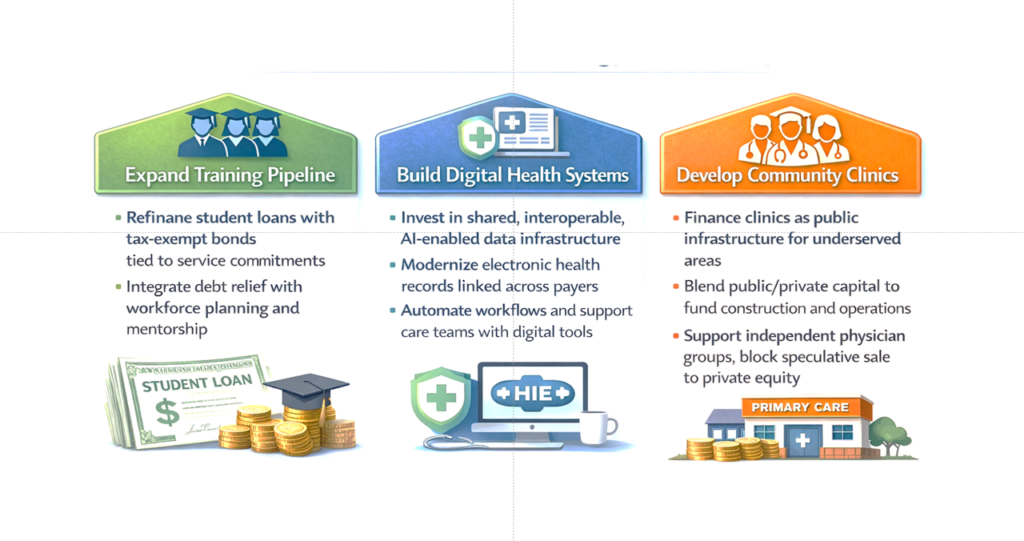
A former healthcare investment banker contends that strengthening primary care requires a three-part state-based capital investment strategy: increasing the primary care workforce; deploying artificial intelligence and related information technology to improve quality and productivity; and making long-term capital investments in primary care organizations.
Better Healthcare Policy Group


In 2020, Mr. Wadsworth helped bring together the original members of the Better Healthcare Policy Group (BHCPG) and has subsequently identified additional key members. He has provided leadership to the group in the areas of strategic planning, quality improvement and outcomes reporting.

BHCPG members (from left to right): Jon M. Kingsdale, PhD., Dr. John Toussaint, Prof. Stephen M. Shortell, Allyson Y Schwartz, Gail Wilensky, PhD., George C. Halvorson, Peter A. Wadsworth, Prof. Richard M. Scheffler.
In 2023 we published a white paper entitled: The Better Care Plan: a blueprint for improving America’s healthcare system. Key features of the BCP are the use of Better Care Teams to provide comprehensive, patient centered care without the perverse incentives of fee-for-service medicine, continuous quality improvement and Publicly Reported Health Outcomes (PRHOs) to empower purchasers to choose based on quality as well as cost. We are currently working with Prof. Stephen Shortell and Dr. John Toussaint on a Patient Safety and Outcomes Reporting implementation plan, and we are developing blueprint for quality improvement in the Employer-sponsored Insurance (ESI) market.
Services Offered
In addition to financially-oriented strategies, Amory Associates offers these services
- Health Policy/Strategy Briefs: Public & Private sector
- Industry & legislative analysis
- Board & C-level consultations
- C-level financial reporting
- Financial Modelling
- Valuations & debt capacity studies
- Consumer-oriented health solutions