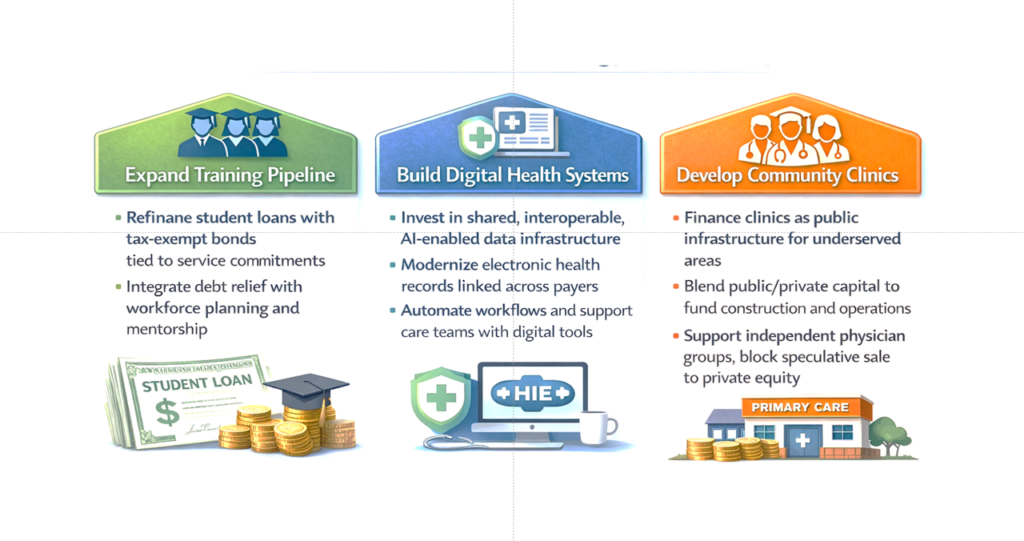
This work began with Rethinking Primary Care Investment Strategy, which was published in January 2026. That article argued that primary care investment had been defined too narrowly as increasing annual reimbursement. Although higher operating payments are necessary, they do not by themselves create the workforce, facilities, information systems, and organizational capacity required for a high-functioning primary care system.
The article proposed a three-part state-based capital investment strategy: expand the primary care workforce and training pipeline; build shared information infrastructure, including interoperability and appropriate uses of AI; and finance the facilities and high-functioning primary care organizations needed to serve the population. Drawing on the financing experience of hospitals, it argued that states should use long-term financing and other capital tools to build durable primary care capacity rather than relying entirely on annual spending.
Further research showed that these three investment priorities addressed what states needed to build, but not the complete process required to plan, organize, finance, manage, and improve a statewide primary care system. States would also need explicit goals, rigorous needs assessment, governance safeguards, provider-system design, reimbursement reform, data and reporting, and continuous quality improvement. That broader inquiry produced the Nine Key Levers framework.
A subsequent companion proposal, the Primary Care Investment Fund, develops the original article’s capital-financing argument by describing how a state could organize and finance practice-level assets and shared statewide infrastructure.