“High-quality primary care is the foundation of the health care system. Without access to high-quality primary care, minor health problems can spiral into serious illness, chronic diseases go unmanaged, and the opportunity to prevent illness is lost.”[1]
While high-quality primary care is the foundation of an effective health system, simply setting an ambitious primary care spending target does not guarantee better care, access, or equity. In recent years, more states have announced plans to increase or even “double” primary care spending as a share of total health expenditures. Yet only a small number have authorized, enforceable targets, and only two have actually reached them so far. The Nine Key Levers framework grew out of the research and analysis in connection with Rethinking Primary Care Investment Strategy.
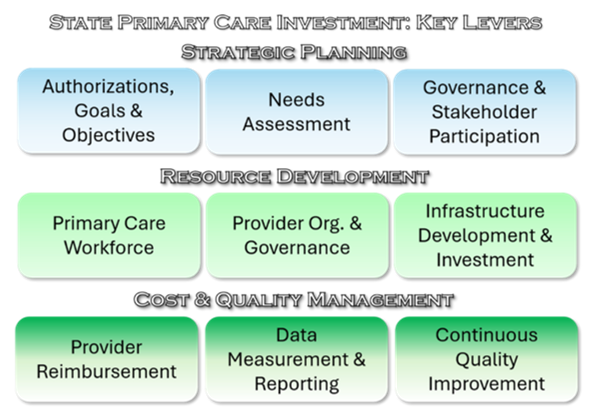
The Nine Key Levers can serve as a framework for implementation, an interview guide, a basis for evaluating existing plans, or an instructional resource. This page is intended as a series guide and table of contents and will be updated periodically until the series is complete. Please check back from time to time as additional articles are published.
Key Lever 1 – Authorizations, Goals & Objectives: from Spending Targets to Plans
Key Lever 2 – Primary Care Needs Assessment
Key Lever 5 – Provider Organization & Governance: Designing a Statewide Primary Care System
Key Lever 6 – Infrastructure Development & Investment: Building State Primary Care Capacity
Key Lever 7 – Primary Care Reimbursement: Overcoming the Challenges
Key Lever 8 – Data Measurement & Reporting: Connecting & Managing the Primary Care System
Key Lever 9 – Strengthening Statewide Primary Care through Continuous Quality Improvement
[1] Implementing High-Quality Primary Care: Rebuilding the Foundation of Health Care, National Academies of Sciences, Engineering, and Medicine, 2021
PrimaryCareInvestment #StateHealthPolicy #HealthcarePolicy #HealthcareGovernance #PrimaryCareTransformation #PrimaryCareWorkforce #KeyLevers