A former healthcare investment banker contends that strengthening primary care requires a three-part state-based capital investment strategy: increasing the primary care workforce; deploying artificial intelligence and related information technology to improve quality and productivity; and making long-term capital investments in primary care organizations.
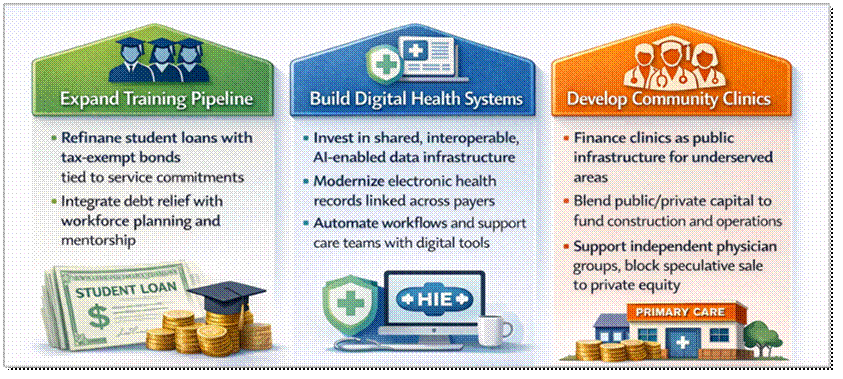
This article contends that in many cases “primary care investment” has been too narrowly defined as higher annual operating payments. According to a recent article in JAMA, spending increases alone are unlikely to address persistent access gaps and poor U.S. outcomes relative to peer countries. Accordingly, the author proposes a state-led capital investment strategy to build durable primary care workforce capacity, alongside payment reform and productivity tools such as interoperability and AI. Based on HRSA projections of a primary care physician shortfall of 87,150 by the mid-2030s just to keep pace with current levels of care, the article estimates that the training and pipeline resources required to materially expand primary care could reach $100 billion. States that want to materially improve primary care coverage will need to spend significantly more on facilities, IT infrastructure and working capital. The author outlines a three-part investment strategy to do so.
Why States Need Primary Care Investment
The United States lags behind other developed nations on mortality and health outcomes, with chronic underinvestment in primary care a widely cited explanation. The U.S. typically devotes about 5 percent of health-care spending to primary care, compared with roughly 15 percent in many peer countries.
Recent commentary reinforces that higher payment alone is insufficient. A JAMA Viewpoint article asked whether paying primary care more would finally solve access problems and concluded “not by itself.” And a recent article from the National Association of Community Health Centers for Primary Care states that one-in-three adults lack a primary care provider. A 2022 Primary Care Collaborative (PCC) Evidence Report shows that the percentage of Americans with an ongoing primary care relationship has been declining
Technology, including AI-enabled workflow tools and better data exchange, can help expand access and reduce administrative burden. But these gains typically require upfront financing for shared infrastructure, interoperability, and implementation. This article focuses on that missing piece: practical ways states can use capital financing, alongside payment reform and technology, to build durable primary care capacity.
The purpose of this article is to show how a robust capital investment plan can complement an annual state spending plan to help rebuild primary care physician capability that meets the future needs of your state more effectively.
Obstacles to Meeting States’ Primary Care Needs
The primary care physician shortage stems from structural, mutually reinforcing factors. Burnout and early retirement thin the ranks of experienced clinicians. Too few medical-school graduates choose primary care, in part because compensation remains lower than in most specialties while student debt often exceeds $250,000. But lack of primary care training capacity in medical schools is a significant contributing factor. Existing practices concentrate in urban and suburban areas, leaving rural and underserved communities chronically short of physicians. Together, these forces create a vicious cycle in which fewer physicians mean heavier workloads, declining morale, and reduced access to care.
The consequences ripple through the health system. Populations without adequate primary care experience higher rates of chronic illness, delayed diagnoses, and shorter life expectancy. As patients turn to emergency departments and specialists for routine needs, costs rise and efficiency declines. The impact falls hardest on low-income families, rural residents, and underserved urban communities.
The Cost of the Primary Care Gap
Federal projections indicate a substantial primary care physician shortfall by the mid-2030s. The Health Resources and Services Administration projects a shortage of 87,150 PCPs by 2035–2037, the minimum needed just to preserve today’s access patterns adjusted for population growth and aging. If we assume that we need to provide PCPs for all Americans who currently lack a source of primary care, we will need to increase the PCP “supply” by 50 percent. Based on the HRSA estimate and the author’s calculations, this would require an additional 158,500 PCPs by 2036. On the other hand, some experts in the field believe that successful deployment of AI and substantially increasing the ratio of primary care advanced practice clinicians (APCs) to PCPs, could reduce these estimates significantly.
Currently, the medical education and residency system lacks the capacity and financing to train that many PCPs at the required pace. Published analyses estimate that producing a new primary care physician will cost approximately $1 million, inclusive of medical school and residency training. Training new nurse practitioners is estimated to be substantially less.
Assuming about $1 million per PCP as a conservative planning estimate, closing the conservative HRSA shortfall (87,150 PCPs) implies on the order of $80–$90 billion in additional training resources over time, while aiming for a higher‑access benchmark would require well over $150 billion, underscoring why long‑term, tax‑advantaged capital must be part of any serious primary care strategy. It should be noted that this estimate does NOT include: (1) additional PCPs to serve the currently unserved; or (2) the cost of IT and health center infrastructure, which is beyond the scope of this article.
True Primary Care Investment
Capital investment is the expenditure of funds to acquire, construct, or substantially improve long‑lived tangible assets that will provide services or economic benefits over multiple future years, such as buildings, equipment, infrastructure and other depreciable assets.
In health policy discussions “investing in primary care” typically means increasing annual spending. In finance, however, investment typically means deploying capital today to finance assets that will generate returns over future years. In primary care, true investment means building productive capacity: workforce, clinics, and enabling infrastructure.
Consider a hypothetical state that increases its primary care share of health-care dollars from 5 percent to 15 percent over ten years. A one-percent annual operating increase could support five to sixteen times that amount in long-term capital investment without breaching balanced budget limits. Using recent Aa/AA tax-exempt municipal bond rates (approximately 2.7–4.3 percent as of November 2025), such a state could raise $4.6 million to $16.7 million in capital proceeds for the same annual budget impact. Bonds allow states to spread the costs of acquiring or building assets across the life of those assets.
Hospitals demonstrate the power of sustained capital investment. Over decades, they have grown through tax-exempt bonds and public-private partnerships, becoming dominant economic forces. Primary care, by contrast, has relied almost entirely on current revenue, leaving it fragmented and undercapitalized. Extending comparable financing tools could begin to correct that imbalance.
Several states already move in this direction. Maryland funds new clinics in underserved areas; New York and Massachusetts use health-facility authorities and community-development finance to support primary-care projects. California’s CalAIM program invests billions in community infrastructure.
High-Functioning Primary Care Groups are Essential
Simply spending more money on the existing fragmented system will, at best, produce a larger, more expensive fragmented system. Capital alone will not fix our current dysfunctional primary care system either. The objective is not simply to use capital well, but to improve both the quality and the quantity of primary care delivered statewide. To do that, states will need to develop comprehensive plans that define what a high-functioning primary care group looks like, how to help existing groups evolve toward that model, and how to build enough of these organizations to meet their residents’ primary care needs.
High‑functioning primary care organizations deliver coordinated, patient‑centered care with measurable improvements in outcomes. Evidence from the Robert Graham Center and others suggests that physician‑led and independent medical groups can deliver better outcomes and lower costs than hospital‑owned practices, especially when they have strong primary care and are accountable for population health outcomes. These are the kinds of organizations that primary care capital should build and strengthen, so that new funding translates into better access and outcomes rather than just higher spending.
For more information on the characteristics of high functioning primary care groups, the reader may wish to consult a Health Affairs article that we’ve written on the subject. In addition, we encourage the reader to explore the work done by Massachusetts Health Quality Partners (MHQP) and Minnesota Community Measurement (MNCM), both of which provide comprehensive information on the quality of primary care groups in their respective states.
The paradigm shift we propose here is to use capital to quickly and effectively build capacity for high‑quality primary care that serves the entire population, especially underserved communities, and measurably improves health outcomes. States should focus on:
- Expanding facilities and rebuilding the workforce in communities with limited access to care.
- Supporting independent, community-based medical groups that are locally governed and reinvest in quality and access.
- Equipping providers with modern technology and infrastructure to coordinate care and improve efficiency.
- Measuring success clinically through reductions in Treatable Mortality, improvements in morbidity, and decreases in avoidable hospital use.
A Three-Part State-Based Primary Care Investment Strategy
Primary care needs a capital strategy, led by states, which treats it as the backbone of a sustainable health system. States are uniquely positioned to act. They regulate payers, oversee Medicaid, and license providers. Because states hold authority to issue tax-exempt debt and set reimbursement requirements, they can deploy capital strategically rather than rely solely on annual appropriations.
1. Expand the Primary Care Pipeline
Two root causes drive the shortage: early retirements and too few graduates entering primary care. Student loans exceeding $250,000 steer many students toward higher-paid specialties. Federal student loans for 2025–2026 carry rates from 7.94% to 8.94%, while state borrowing rates range from 2.35% to 4.6%. State-financed primary care loans offer compelling alternatives for medical students not yet committed to a specialty. Proposed Actions:
- Refinance student loans with tax-exempt bonds, lowering interest rates in exchange for 8–10 years of primary-care service in designated areas, with proportional claw-backs for early exit.
- Integrate debt relief with workforce planning, tying financing to geographic and specialty shortages identified through state data and pairing refinancing with mentorship and practice-startup support.
- Align capital tools and policy, including tax-exempt bonds, credit guarantees, and supportive legislation to sustain investments over time while coordinating with public-health agencies to maximize impact.
- Leverage state medical schools and GME authorities to increase output of primary care and behavioral health clinicians through service-linked loan forgiveness and tuition support.
While three- to five-year time horizons are typical in strategic planning and financial forecasting, primary care workforce investment warrants a 10-year horizon because oof the length of time required to education and train a physician.
2. Invest in Information Infrastructure
High-functioning primary care depends on information infrastructure as much as physical facilities. Leading organizations demonstrate what is possible with better data exchange, integrated care-management workflows, and targeted AI tools that improve productivity and diagnostic accuracy. Many practices still operate with fragmented records, limited interoperability, and insufficient analytic capacity, leading clinicians to spend excessive time on documentation and administration.
States can use long‑term financing tools to fund interoperable shared data platforms, modern electronic health records that securely share patients’ medical information across providers and payers, and AI‑supported tools that help manage panels and automate routine workflows. Done well, these investments raise primary care productivity, reduce burnout, and allow each physician to care for more patients safely, making it more feasible to close the projected primary care physician gap by the mid‑2030s.
3. Invest in Primary Care Facilities & Medical Groups
Access depends on infrastructure. Many low-income and rural communities lack local, fully equipped clinics. Primary care should be treated as civic infrastructure—no less essential than schools or utilities. Clinic development requires capital for construction, equipment, digital systems, and working capital during early operations. States can establish an all-payer Primary Care Capital Support (PCCS) payment program that is site-neutral, clinic-specific, and dedicated to amortizing community-clinic capital costs. Proposed actions:
- Treat primary care clinics as public infrastructure, prioritizing investment in medically underserved and high-mortality communities.
- Create PCCS payment authority, mandating all payers to participate in financing legitimate capital costs, just as they do for hospital facilities.
- Blend public and private capital, combining state bonding authority, community-development finance, and targeted federal credits.
- Standardize capital reporting and develop a capital-planning framework, with state health agencies maintaining five-year capital plans parallel to hospital processes and tied to access and quality metrics.
Most physician groups today are owned by hospitals or private equity, which often use primary care as a referral engine rather than a prevention hub. States should support independent, community-governed primary-care and multi-specialty groups that reinvest in access and care improvement. Proposed Actions:
- Establish state-backed capital vehicles. Offer loans and guarantees for physician-led or community-owned practices that meet defined public-interest criteria.
- Require physician-majority governance with community representation and strict conflict-of-interest safeguards.
- Link eligibility to measurable outcomes such as treatable mortality, morbidity, improved access, reduced avoidable hospital use, and better chronic disease control.
- Adopt global-budget or capitated payment models with risk adjustment, stop-loss protection, and transparent financial reporting.
- Prevent speculative ownership. Prohibit sale to private-equity or hospital systems unless approved by an independent state authority.
Community-development lenders such as Capital Impact Partners and the Primary Care Development Corporation have shown that primary care can be financed like other essential infrastructure. States can build on these models, using valuation caps and mission covenants to ensure accountability and sustainability.
Feasibility
To the best of the author’s knowledge, no state has yet assembled a full Primary Care Investment Plan that simultaneously targets workforce, information infrastructure, and facilities through a unified capital strategy. But state financing tools currently in use illustrate that each component is legally and politically feasible.
1. Workforce expansion capital
States such as Massachusetts, New York, and Connecticut already use health and educational facilities authorities to issue tax‑exempt bonds for medical schools and teaching hospitals, effectively capitalizing the physician training pipeline. Redirecting or prioritizing these bond programs for primary care residencies, community training sites, and behavioral health integration would help operationalize the workforce component of a Primary Care Investment Plan.
2. Information infrastructure capital
Massachusetts, Colorado, Maine, New Hampshire, Utah, and Virginia have all treated clinical data infrastructure as a public asset by creating statewide health information exchanges and all‑payer claims databases funded and governed at the state level. For example, Massachusetts funds the Center for Health Information and Analysis (CHIA), which maintains the all-payer claims database and related analytic infrastructure. Applying similar capital-style funding to statewide clinical databases and targeted AI-enabled tools would strengthen the information infrastructure leg of a Primary Care Investment Plan.
3. Facilities and medical group capital
Federally qualified and community health centers in roughly thirty states have access to tax‑exempt bond financing through statewide issuers. Health centers in those states routinely use tax‑exempt bonds to finance clinic acquisition, construction, and major equipment. Extending these proven capital structures to independent, high‑performing primary care groups and networks would scale the facilities and group component of a Primary Care Investment Plan beyond the safety‑net sector.
Conclusions
Building a sustainable primary care capability with proper governance and incentives requires a Primary Care Investment Plan that includes a robust capital investment component, not just higher annual operating spending and a patchwork of existing funding programs. Rebuilding a primary care workforce that is adequately supported by infrastructure will be expensive. Relying only on existing funding mechanisms is unlikely to be sufficient. A robust funding plan along the lines proposed herein can improve access, reduce avoidable hospital use, and produce measurable improvements in mortality and morbidity over time.
The recommended Primary Care Investment Plan is feasible because states already use financing tools to fund public facilities. Treating medical education, clinics, and community organizations as capital assets can unlock large-scale financing while meeting balanced budget requirements and limiting near-term budget impact. This capital financing is intended to build durable primary care capacity, not just fund year-to-year operations. The Plan should prioritize the workforce pipeline, IT infrastructure, and financial support for primary care practices, using tools such as tax-exempt bonds, credit enhancement, loan guarantees, and dedicated taxes or assessments as appropriate. Success will require alignment among state executives, legislators, stakeholders, and federal partners; without it, results will likely fall short of health improvement goals.
Some states are already committed to ambitious primary care “investment” plans but typically address only a portion of the recommended strategy. States that remain uncommitted risk higher costs and poorer health outcomes.
Peter A. Wadsworth – January 20, 2026
Acknowledgments
The author wishes to express his appreciation to his Better Healthcare Policy Group colleagues for their contributions and feedback.
#PrimaryCareInvestment #StateHealthPolicy #HealthCareFinancing #PrimaryCareWorkforce #AIinHealthcare #HealthITInfrastructure #TaxExemptBonds #CommunityHealthCenters #HealthEquity #PopulationHealth #ValueBasedCare #HealthcareCapital #MedicaidInnovation #PrimaryCareAccess #HealthSystemReform #PrimaryCareQuality #HealthQuality #MHQP #QualityMeasurement #CHIA